
Balenciaga: Did the House Really Change?
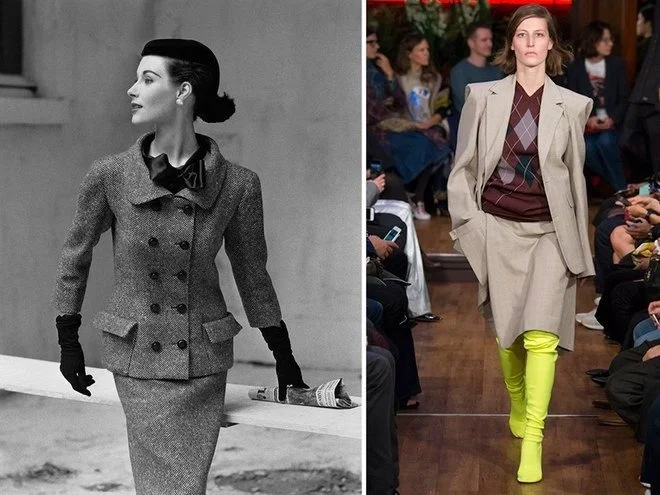
Driven by shock factor, harsh criticism, and scandals in recent years, the fashion house of Balenciaga has achieved a major cultural impact like never before in the modern world. The main criticism of Balenciaga now is how drastically the fashion house had changed from its origins of Cristobál Balenciaga in 1917. The use of leather, masks, metal and dystopian clothing structures have allowed the house to gain fame through social media, influencers, celebrities and younger generations, but possibly for the wrong reasons. It has been criticized as lazy in design, made for shock factor and as even disgraceful. I confess that I also jumped on this bandwagon of disliking the new era of Balenciaga, believing that it had turned into leather streetwear instead of conserving its idea of elegance and creating wearable art. However, upon researching the origins of Balenciaga, it is apparent that maybe the house never truly strayed away from its roots at all.
Photo/Pinterest
The Origin of Balenciaga
Cristobál Balenciaga, born in the Basque region of Northern Spain, began his fashion career at the age of twelve, taking apprenticeships from tailors in San Sebastian, a region known for vibrant arts and rich Basque culture. He first opened fashion houses in Spain named “Eisa,” a shortened version of his mother’s maiden name. In Paris, he established Balenciaga on Avenue Georges V, which quickly blossomed into one of the city’s most exclusive courtiers. Reflecting on his culture and ethnic background, he took inspiration from Spanish designs such as Matador jackets and Flamenco dresses. These intricate and innovative outfits would earn him the reputation as a designer who was meticulously involved in every step of his creations. From sketching, picking materials, cutting the fabrics and assembling the garments, Balenciaga’s comprehensive knowledge set him apart from other designers. Coco Chanel praised him as “...a couturier in the truest sense of the word. Only he is capable of cutting material, assembling a creation and sewing it by hand, the others are simply fashion designers.”
What is Balenciaga’s trademark?
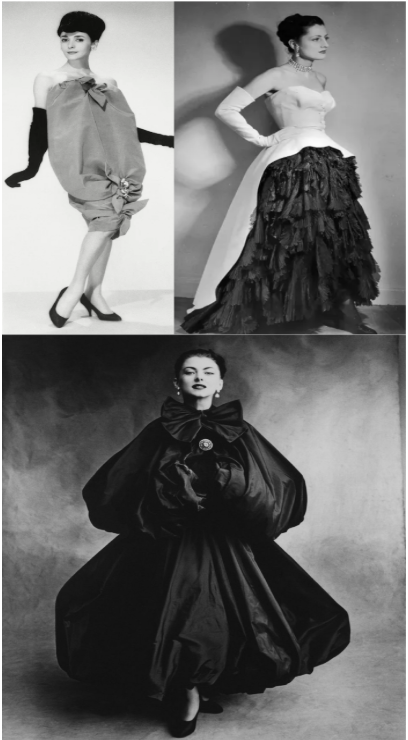
Known for abstract structures and futuristic designs, Balenciaga established statement pieces that are still being used as a source of inspiration for contemporary fashion. In the 1950s, Balenciaga began creating shapes in women’s fashion that were never seen before, most notably the “sac dress.” The “sac dress” was notable for introducing cocoon lines, which rebelled against the form-fitting silhouette. Instead, the lines slanted downward, creating a baggier and unproportional shape to the body. It strayed from the idea of femininity and fashion rules of the 1950s, where fit-and-flare was a defining style for women. The style came with criticisms claiming it was unflattering and had little sex appeal. However, in true Balenciaga fashion, the “sac dress” became the pioneer of the babydoll mini-dress of the 1960s, which remains a fashion staple to this day. Another signature piece that defined the house was the parachute dress. Living up to its name, the parachute dress engulfed the wearer in fabric and gave a striking resemblance to…well…an actual airborne parachute. Utilizing balloon-filled hems, he made dresses and jackets so voluminous to a point that they looked as though they were magically inflated and refused to succumb to gravity. To make the skirts of the dresses even more expansive, he added tulle and designed the skirts to have asymmetric lines with the front of the skirt lifted or open.
When did Balenciaga start “changing?”
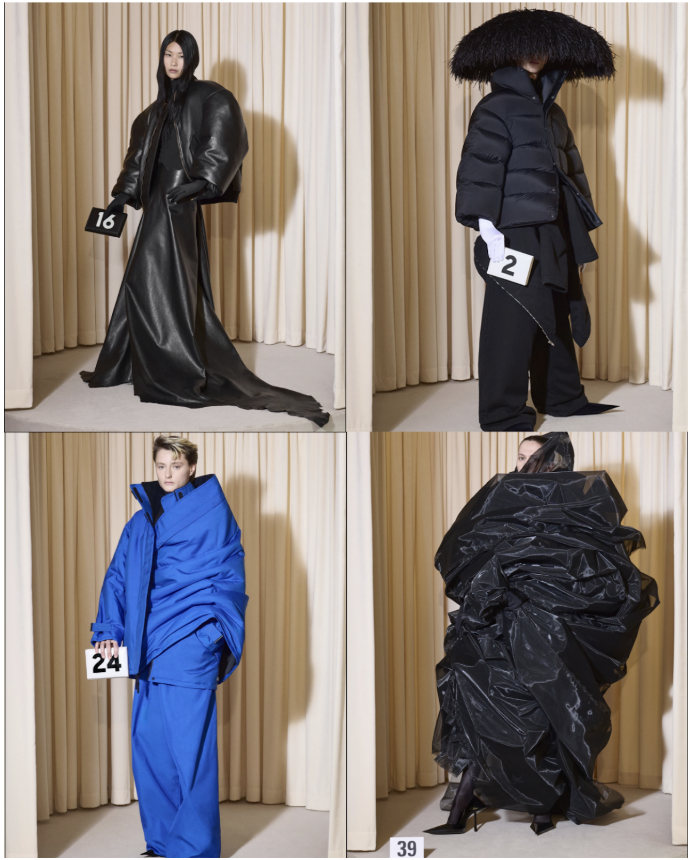
In recent years, critics, influencers, and fashion celebrity connoisseurs have claimed that Balenciaga has changed dramatically and strayed far from its origin of elegance and innovation. This has been especially noticeable in the career of Balenciaga’s last creative director, Demna Gvasalia (2015-2025). Gvasalia’s designs have been labeled as “absurd” and “uneasy” as he combines bold structural patterns, materials like leather and metal, technology like 3D printing and surprisingly minimal designs. However, did he really change the idea of Balenciaga that Cristobál Balenciaga so prominently defined? Quite the contrary. Going back to Gvasalia’s past couture shows, such as the 53rd couture collection, he still keeps the components of Cristobál Balenciaga. At first glance, half the show looks like street wear, and the other half are asymmetrical gowns and fabric devouring the models. Closer examination, however, reveals that the focal point of his street wear is actually the hats. Created with feathers crowning down, Gvasalia takes inspiration from Cristobál’s wide-brimmed hats but also his day cap and pill box cap, which are rounded and covered in rayon taffeta and/or cockerel feathers. In the second half of the show, we begin seeing the parachute dress, cocoon silhouette, and peacock line. The last dress in the collection (look 39) completely captures Cristobál’s technique of using “balloon hems” to create volume and an illusion of the dress being filled with air, engulfing the model. Looks 22-25 utilize the cocoon silhouette, with the jackets encasing and wrapping around the model. Gvasalia transforms puffers, bombers, and jean jackets into an asymmetrical arch curve, creating volume but also sharp lines and textures. Look 16 seems to be a slight interpretation of the peacock line. The peacock line is designed as a simple shape with a long, asymmetrical skirt that has a train resembling a “peacock tail.”
Photos/Balenciaga/Balenciaga 53rd Couture Collection
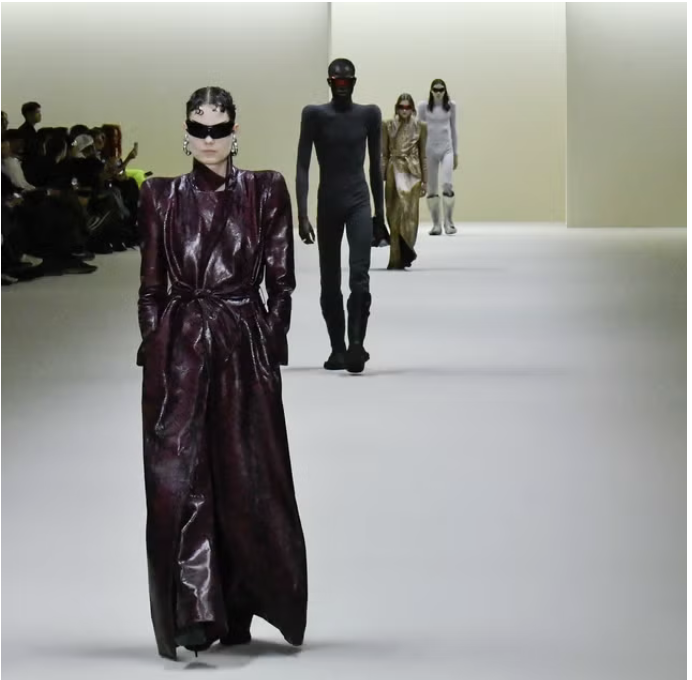
While Demna Gvasalia is often chastised for his strange, futuristic designs as they lack the aesthetic pleasingness of a ballgown or an A-line skirt, one must ask the question: Is that not what Balenciaga is all about? Is it not to pioneer new shapes or designs and create an idea about what the future of fashion could be? Just as Cristobál Balenciaga envisioned the future of fashion, Gvasalia does the same, and maybe this exposes that the future makes people uncomfortable and unsure. But sure enough, it becomes accepted and a new inspiration for the next generation. Art is supposed to invoke emotions, to summon reactions, and compel the observer to feel, whether that be awe or discomfort. Ballooning skirts in 1950 were bizarre then, and bodysuits with 3D printed masks are bizarre now. As history repeats itself, the house operates ahead of the curve, waiting for us observers to catch up and accept the future of fashion. The House of Balenciaga remains true to its roots - it is not that the brand has changed, but that its constant focus on the future continuously challenges the status quo.


Photo/Harper’s BAZZAR/Balenciaga Winter 23
Editor: Sydney Annis
Graphic: Sarah Rakoski